What Is the Mark a Mixed Race Baby Has Near Their Tailbone
| Slate grey nevus | |
|---|---|
| Other names | Mongolian spot, Mongolian blue spot, built dermal melanocytosis,[1] dermal melanocytosis[1] |
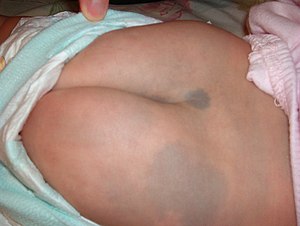 | |
| Infant with slate grey nevus | |
| Specialty | Dermatology |
A Mongolian spot, also known every bit slate grey nevus or congenital dermal melanocytosis, is a benign, apartment, congenital birthmark with wavy borders and an irregular shape. In 1883, information technology was described and named after Mongolians past Erwin Bälz, a German anthropologist based in Japan, who erroneously believed it to be most prevalent amidst his Mongolian patients.[two] [3] [4] [5] Information technology normally disappears iii to five years after birth and almost always by puberty. The most common color is blue, although they can be blue-gray, blue-black or deep chocolate-brown.
Cause [edit]
Mongolian spot is a built developmental status—that is, i existing from nascence—exclusively involving the skin. The blue colour is acquired past melanocytes, melanin-containing cells, that are usually located in the surface of the skin (the epidermis), but are in the deeper region (the dermis) in the location of the spot.[6] Ordinarily, every bit multiple spots or one big patch, it covers i or more of the lumbosacral area (lower back), the buttocks, sides, and shoulders.[6] Information technology results from the entrapment of melanocytes in the lower half to 2-thirds of the dermis during their migration from the neural crest to the epidermis during embryonic evolution.[6]
Male and female person infants are equally predisposed to slate grey nevus.[7] [viii] [9] People who are not aware of the background of the slate grey nevus may mistake them for bruises, possibly resulting in mistaken concerns nearly abuse.[10] [11] [12]
Anthropological clarification [edit]
The French anthropologist Robert Gessain interested himself in what he called the tache pigmentaire congenitale or coloured birthmark, publishing multiple papers in the Periodical de la Société des Américanistes, an bookish periodical covering the cultural anthropology of the Americas. Gessain spent time with the Huehuetla Tepehua people in Hidalgo, Mexico, and wrote in 1947 virtually the spot's "location, shape, colour, histology, chemistry, genetic manual, and racial distribution". He had previously spent several winters in Greenland, and wrote an overview in 1953 of what was known about the spot. He hypothesised that the age at which it faded in various populations might testify to be a distinguishing characteristic of those groups. Gessain claimed that the spot was starting time observed amidst the Inuit.[xiii]
Hans Egede Saabye, a Danish priest and botanist, spent 1770–1778 in Greenland. His diaries, published in 1816 and translated into several European languages, independent much ethnographic information. He described the spot on newborns, maxim he had seen it often when the infants were presented naked for baptism. A 2nd Danish observer was md and zoologist Daniel Frederik Eschricht, mainly based in Copenhagen. In 1849 he wrote of the "mixed" babies he had delivered at the lying-in hospital. He also says that "the observation made for the first time by Saabye about Inuit children has been completely confirmed by Helm Holbøll", who sent him a fetus pickled in alcohol.[13]
Gessain goes on to land that information technology was only in 1883 that an anthropologist mentions the spot. It was Erwin Bälz, a German working in Tokyo, who described a night bluish mark on Japanese infants. He presented his findings in 1901 in Berlin, and from that point on, Bälz'due south name was associated with certain skin cells containing pigment. Captain Gustav Frederik Holm wrote in 1887 that his Greenlandic interpreter Johannes Hansen (known as Hanserak) attested to the existence of the birthmark over the kidney region of newborns, which grows larger as they abound older. That year, the Danish anthropologist Soren Hansen drew the connection between the observations of Bälz in Nippon and Saabye in Greenland. "This cannot exist a coincidence. It is non the first time that the resemblance between the Japanese and the Eskimo has been pointed out." Fridtjof Nansen, the Norwegian polar explorer, said that the spot was widespread in the mixed Danish-Inuit population of West Greenland. Soren Hansen confirmed this. A missionary in Bethel, Alaska, a traditional gathering identify of Yup'ik people, reported that the spots were common on children. Rudolf Trebitsch, an Austrian linguist and ethnologist, spent the summertime of 1906 on the West Declension of Greenland, and listed all the examples he came beyond. Gessain went to north Labrador in 1926, looking for children with these spots. In 1953 Dr Saxtorph, medical advisor to the Greenland department (part of the Danish government), wrote that the Greenlanders do non like outsiders to meet or discuss these birthmarks; "they doubtless feel as a reminiscence of the time when they lived on a depression cultural level".[xiii]
The presence or absenteeism of the slate grey nevus was used by racial theorists such as Joseph Deniker (1852-1918), the French anthropologist.[14]
The Periodical of Cutaneous Diseases Including Syphilis, Volume 23 independent several accounts of the slate grey nevus on children in the Americas:
Holm ("Ethnological Sketch. Communications on Greenland," 10., Copenhagen, 1887) announced the presence of the spot in the east part of Greenland. Bartels ("The So-Chosen 'Mongolian' Spots on Infants of Esquimaux," Ethnologic Review, 1903) received letters regarding it from E Greenland and also from Esquimaux of Alaska. In half-brood European-Esquimaux, Hansen says he has encountered information technology. Amid Indians of Due north Vancouver, British Columbia, at that place are observations fabricated by Baelz also equally by Tenkate (secondhand). In the Mayas of Central America, Starr'due south (Information on the Ethnography of Western Mexico, Role H., 1902) facts are corroborated past Herman (Aparecimiento de la Mancha Mongolica. Revista de Ethnologia, 1904). He cites A. F. Chamberlain (Pigmentary Spots, American Anthropologist, 1902,) and Starr (Sacral Spots of Mayan Indians, Scientific discipline, New Series, xvii., 1903).
In Key America, co-ordinate to these authorities, the spot is called Uits, "pan," and it is an insult to speak of it. It disappears in the tenth calendar month. Information technology is bluish-blood-red (in these Native people), and is remarkable by its small size. The mulberry colored spot is very well known in Afro-Brazilians. In Brazil, amidst individuals of mixed Indigenous American and W African descent (pardo) information technology is chosen "genipapo", from its resemblance in color (blue-grey) to an indigenous fruit of Brazil, named genipapo (a Native discussion adopted into Portuguese).
Prevalence [edit]
Infants may be born with one or more slate greyness nevus ranging from pocket-sized area on the buttocks to a larger area on the dorsum. The birthmark is prevalent amidst Due east, S, Southeast, North and Central Asian peoples, Indigenous Oceanians (chiefly Micronesians and Polynesians), sure populations in Africa,[xv] Amerindians,[16] non-European Latin Americans and Caribbeans of mixed-race descent.[six] [17] [18]
They occur in effectually 80%[19] of Asians, and eighty%[19] to 85% of Native American infants.[17] Approximately xc% of Polynesians and Micronesians are born with slate grey nevus, as are about 46% of children in Latin America,[xx] where they are associated with non-European descent. These spots too appear on v–10% of babies of full Caucasian descent; Coria del Río in Spain has a high incidence due to the presence of descendants of members of the delegation led past Hasekura Tsunenaga, the showtime Japanese official envoy to Spain in the early on 17th century.[17] [21] [ better source needed ] African American babies have slate grayness nevus at a frequencies of 90%[19] to 96%.[22]
Co-ordinate to a 2006 study examining the Mongolian spot amongst newborns in the Turkish city of İzmir, it was found out that 26% of the examined babies had the condition. It was noted the prevalence charge per unit was xx% and 31% in boys and girls, respectively. The report also reported that no children born with calorie-free hair had the mark, meanwhile 47% of the children with night pilus having it.[23]
Since the last century, all-encompassing research has been made regarding the prevalence of said spot in populations of mixed European-Amerindian ancestry. A publication from 1905, citing field inquiry made by the anthropologist Frederick Starr, states that the spot is not present in Mestizo populations,[24] nonetheless, if Starr'southward actual research is consulted it is observed the he declares that "7 Mayan children presented the spot, iii mixed children didn't have information technology...",[25] Starr therefore does not make an absolute judgement, as he does not say how many mixed children were analyzed in full. Nowadays information technology is completely accepted that the large majority of Mexico'south and Latin America's mixed-race populations have the Mongolian spot[26] and that its presence works every bit an indicator of the bodily degree of mestizaje present in a given population,[27] having its lower frequency in Uruguay with 36%,[27] followed by Argentina with an incidence 44%,[28] Mexico with l%-52%,[29] 68% on Hispanic-Americans[30] and 88% on highland Peruvians.[31]
A study performed in hospitals of Mexico City reported that, on average, 51.8% of Mexican newborns presented slate grey nevus, while it was absent on 48.two% of the analyzed babies.[28] According to the Mexican Social Security Institute nationwide, around half of Mexican babies accept the slate gray nevus.[32]
Central American ethnic children were subjected to racism due to their slate grey nevus but progressive circles began to make having the slate gray nevus pop after the late 1960s.[33]
Highland Peruvians have the slate gray nevus.[34]
Treatment [edit]
As a congenital beneficial nevus, Mongolian spots do not crave handling and in most cases disappear before adolescence. No cases of malignant degeneration take been reported.
Cultural terminology [edit]
The slate grey nevus is referred to in the Japanese idiom shiri ga aoi ( 尻が青い ), pregnant "to take a blue barrel",[35] [36] which is a reference to immaturity or inexperience.
In Mongolian linguistic communication, it is known as "Хөх толбо".
Korean mythology explains the nevus as a bruise formed when Samshin halmi or Samsin Halmoni (Korean: 삼신할머니), a shaman spirit to whom people pray around childbirth, slapped the baby'southward backside to hasten the baby to quickly become out from the mother's womb.
In Chinese, information technology is referred to as "青痕" (Pinyin: Qīng Hén; literally: blueish marking). Among common folk it is said to be acquired by the Buddhist goddess of childbirth Songzi Guanyin (Simplified Chinese: 送子观音; Pinyin: Sòng Zǐ Guān Yīn; literally: the goddess of baby sending) when she is slapping the babe'south backside, telling it to be born. Others say it is because the baby does not desire to leave the mother'south womb, so Songzi Guanyin will kick it out, leaving the bruise. A small portion of people wrongfully believe information technology is caused when the doctor is slapping the baby's backside to make it cry. Scientifically, it is besides referred to as "蒙古斑" (Pinyin: Měng Gǔ Bān; literally: mongolian spot)
In Central khmer, information technology is known as "khnau" (ខ្នៅ) which translates to 'Mongolian spot' besides as other skin conditions such equally vitiligo and leucoderma.[37]
The marking is also common amid Maya people of the Yucatan Peninsula[38] where is referred to as Wa in Maya, which means "circle".
In Republic of ecuador, the native Indians of Colta are insultingly referred to in Spanish by a number of terms which allude to the slate grey nevus.[39]
In Spanish it is called mancha mongólica and mancha de Baelz (see Erwin Bälz).[forty]
In Iñupiaq, is information technology called auttaq or auktaq, which relates to the word for claret and likewise ways 'mole'.[41]
Come across also [edit]
- Nevus flammeus nuchae, also known as stork bite
- List of cutaneous conditions
References [edit]
- ^ a b Rapini, Ronald P.; Bolognia, Jean L.; Jorizzo, Joseph 50. (2007). Dermatology: 2-Volume Set. St. Louis: Mosby. p. 1720. ISBN978-1-4160-2999-1.
- ^ Die koerperlichen Eigenschaften der Japaner.(1885) Baelz.E. Mittheil.d.deusch Gesell.f.Natur-u-Voelkerheilkunde Ostasiens. Bd.4.H.32
- ^ Circumscribed dermal melanosis (Mongolian spot)(1981) Kikuchi I, Inoue South. in "Biological science and Diseases of Dermal Pigmentation", Academy of Tokyo Press, p83
- ^ Bernard Cohen (1993). Atlas of pediatric dermatology. Wolfe. pp. 6–17. ISBN978-1563750199 . Retrieved May 17, 2014.
- ^ JAMA: The Journal of the American Medical Association, Volume 51. American Medical Clan. American Medical Association. 1908. p. 2262. Retrieved May 17, 2014.
{{cite volume}}: CS1 maint: others (link) - ^ a b c d Mongolian blue spots Archived Jan 19, 2017, at the Wayback Machine – Health care guide discussing the Mongolian blue spot.
- ^ Kroon, Susanne; Clemmensen, Ole Jacob; Hastrup, Nina (September 1987). "Incidence of congenital melanocytic nevi in newborn babies in Denmark". Journal of the American Academy of Dermatology. 17 (3): 422–426. doi:10.1016/s0190-9622(87)70223-0. PMID 3655021.
- ^ Paláu-Lázaro, Yard.C.; Buendía-Eisman, A.; Serrano-Ortega, S. (2008). "Prevalence of Congenital Nevus in chiliad Live Births in Granada, Spain". Actas Dermo-Sifiliográficas (English Edition). 99 (1): 81. doi:10.1016/s1578-2190(08)70202-6.
- ^ Alper, Joseph C.; Holmes, Lewis B. (July 1983). "The Incidence and Significance of Birthmarks in a Cohort of 4,641 Newborns". Pediatric Dermatology. 1 (one): 58–68. doi:x.1111/j.1525-1470.1983.tb01093.x. PMID 6679890.
- ^ Mongolian Spot - English information of Mongolian spot, written by Hironao NUMABE, M.D., Tokyo Medical University.
- ^ Empson, Rebecca M. (2010). Harnessing fortune : personhood, retentiveness and place in northeast Mongolia. Oxford: Oxford University Press. ISBN9780197264737.
- ^ Robert G. Reece; Stephen Ludwig, eds. (2001). Child Abuse: Medical Diagnosis and Management (2, illustrated ed.). Lippincott Williams & Wilkins. p. 180. ISBN978-0781724449 . Retrieved May 17, 2014.
- ^ a b c Gessain, Robert (1953). "La tache pigmentaire congénitale chez les Eskimo d'Angmassalik" [Congenital pigment spot in the Eskimo people of Angmassalik] (PDF). Journal de la Société des Américanistes (in French). 42 (ane): 301–332. doi:10.3406/jsa.1953.2408.
- ^ Deniker, J. (1901). "Les taches congénitales dans la région sacro-lombaire considérées comme caractère de race" [Congenital spots in the sacro-lumbar region considered to be a breed trait] (PDF). Bulletins de la Société d'anthropologie de Paris (in French). two (one): 274–281. doi:10.3406/bmsap.1901.5961.
- ^ Kevin C. Stuart (1997). Mongols in Western/American consciousness (illustrated ed.). Edwin Mellen Press. p. 95. ISBN978-0773484436 . Retrieved May 17, 2014.
- ^ Miller (1999). Nursing Care of Older Adults: Theory and Exercise (three, illustrated ed.). Lippincott Williams & Wilkins. p. ninety. ISBN978-0781720762 . Retrieved May 17, 2014.
- ^ a b c "Well-nigh Mongolian Spot". tokyo-med.ac.jp. Archived from the original on December 8, 2008. Retrieved October 1, 2015.
- ^ Transcultural Medicine: Dealing with patients from different cultures
- ^ a b c Giger, Joyce Newman (2016). Transcultural Nursing – East-Book: Cess and Intervention. Elsevier Wellness Sciences. p. 176. ISBN978-0323400046 . Retrieved September xiv, 2017.
- ^ Epidemiology of Mongolian spot on MedScape
- ^ "Spain'south Japon association has reunion to trace its 17th century roots". The Nippon Times . Retrieved Oct 1, 2015.
- ^ N Silverberg (2012). Atlas of Pediatric Cutaneous Biodiversity: Comparative Dermatologic Atlas of Pediatric Skin of All Colors. Springer Science & Business concern Media. p. 34. ISBN978-1461435648. Archived from the original on 2012. Retrieved May 17, 2014.
- ^ Egemen A, Ikizoğlu T, Ergör South, Mete Asar G, Yilmaz O (July 2006). "Frequency and characteristics of Mongolian spots amongst Turkish children in Aegean region". Turk J Pediatr. 48 (3): 232–half dozen. PMID 17172067.
- ^ Douglass Westward. Montgomery (1905). Journal of Cutaneous Diseases Including Syphilis Volume 23. Vol. 23. American Dermatological Clan. p. 210. Retrieved Oct 27, 2019.
- ^ Brennemann, Joseph (1907). "The Sacral or and then-Called 'Mongolian' Pigment Spots of Earliest Infancy and Childhood, with Especial Reference to Their Occurrence in the American Negro". American Anthropologist. 9 (1): 12–30. doi:10.1525/aa.1907.nine.one.02a00030.
- ^ Lawrence C. Parish; Larry E. Millikan, eds. (2012). Global Dermatology: Diagnosis and Direction Co-ordinate to Geography, Climate, and Civilisation. Thousand. Amer, R.A.C. Graham-Brown, S.N. Klaus, J.Fifty. Pace. Springer Scientific discipline & Concern Media. p. 197. ISBN978-1461226147 . Retrieved May 17, 2014.
- ^ a b "El indio en nuestro arte e histiografía" [ permanent expressionless link ] , IFD de Minas, retrieved February xi, 2020.
- ^ a b Magaña, Mario; Valerio, Julia; Mateo, Adriana; Magaña-Lozano, Mario (April 2005). "Alteraciones cutáneas del neonato en dos grupos de población de México" [Skin lesions two cohorts of newborns in Mexico City]. Boletín médico del Hospital Infantil de México (in Spanish). 62 (ii): 117–122.
- ^ "Tienen manchas mongólicas 50% de bebés", El Universal, 16 de enero de 2012. Retrieved July 3, 2017.
- ^ Lewis B. Holmes (2011). Common Malformations. Oxford University Press. p. 414. ISBN9780195136029 . Retrieved Oct 27, 2019.
- ^ Castillo, F.; Bobbio, F. (June 1997). "Marcas cutáneas en recién nacidos" [Skin markings in newborns]. Dermatología Peruana (in Castilian). vii (ane).
- ^ "Tienen manchas mongólicas 50% de bebés", El Universal, January 2012. Retrieved on July three, 2017.
- ^ Arturo Arias (2007). Taking Their Word: Literature and the Signs of Key America. U of Minnesota Press. p. 239. ISBN978-1452913162. Archived from the original on 2007. Retrieved May 17, 2014.
- ^ Herbert Goldhamer (2015). The Strange Powers in Latin America. Princeton Legacy Library, Rand Corporation inquiry study. Princeton Academy Press. p. 105. ISBN978-1400869152. Archived from the original on 2015. Retrieved May 17, 2014.
- ^ 尻 (in Japanese)
- ^ "The butt is blue": the untold story, Language Log, October 15, 2008.
- ^ Headley, Robert K. (1997). "Cambodian-English Dictionary". SEAlang Library . Retrieved July 21, 2019.
- ^ Life Mag - Ancient and Modern Maya (June 1947)
- ^ Eileen Maynard (1966). The Indians of Colta: Essays on the Colta Lake Zone, Chimborazo (Ecuador). Section of Anthropology, Cornell University. p. 6. Archived from the original on May xxx, 2008. Retrieved May 17, 2014.
- ^ Vox (2012). Vox Super-Mini Medical Spanish and English language Dictionary. Vox dictionaries. McGraw Hill Professional person. pp. 184, 121. ISBN978-0071788632 . Retrieved May 17, 2014.
- ^ https://library.alaska.gov/hist/hist_docs/docs/anlm/200078.pdf
External links [edit]
What Is the Mark a Mixed Race Baby Has Near Their Tailbone
Source: https://en.wikipedia.org/wiki/Mongolian_spot
0 Response to "What Is the Mark a Mixed Race Baby Has Near Their Tailbone"
Post a Comment